
3. Is Artificial Intelligence the answer to managing your channel partner ecosystem?
Today’s Partner Ecosystem business relies on human relationships to reduce friction, maintain flexibility and increase process efficiency. In many cases this is a difficult balance and we see some vendors swing from “focus on pipeline” to “focus on making sure the ecosystem can create value.” These objectives require very different types of partner managers, and therefore support for them.
So what role can and should Artificial Intelligence play in this paradox? - Support and guide pipeline creation and accuracy, or help partners become self-sufficient in doing this for themselves? Or maybe both?
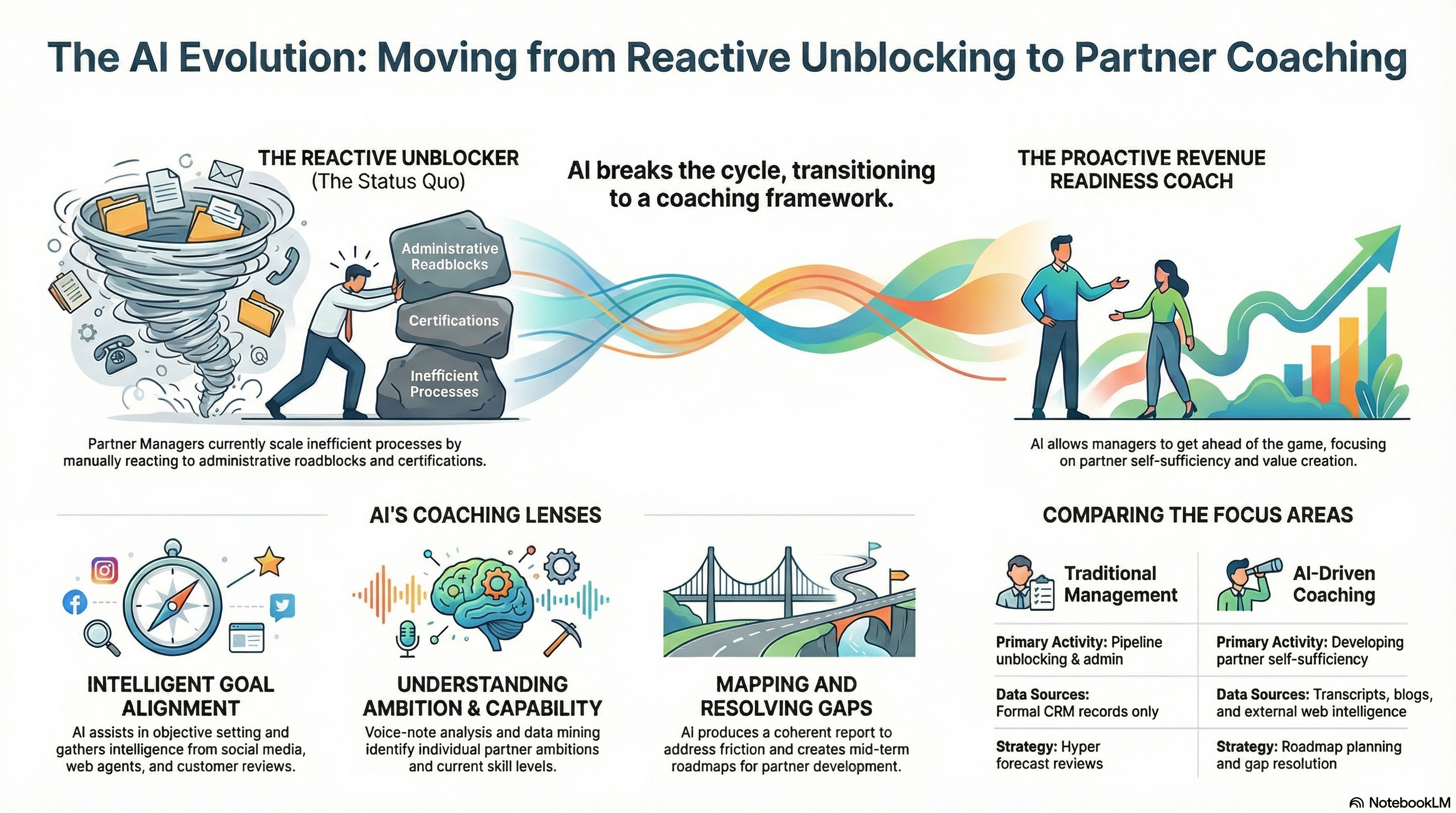
As most vendors have a direct sales force as well as indirect motions, and can control it reasonably well, it is probably a sensible place to start with AI. How do you make a marketing & sales process better? I am sure this is a question most CROs have always been asking, and we see a plethora of stand alone tools and extensions to CRM systems that are addressing this. However, when we take this outside the organisation and into the ecosystem, it rarely helps the Partner Manager whose day is filled unblocking the process to help the deal flow. The partner doesn’t have the right certifications to sell, or isn’t equipped to do the demo. The partner manager is then caught in a tornado of reacting to administrative problems, and not able to get ahead of the game and make sure the partners are “revenue ready” before the sales cycle, or at least 2 steps before the roadblock.. So as we set about doing more transactions with partners we need more partner managers to work around the process. All we do is scale an inefficient process. We will come back to how AI can help fix the process later.
Helping partners become more self sufficient is a long term activity. Enabling their business to work with you for mutual advantage is often a balance between coaching them on how to do business, and how to do it with you and your products. Many times partners are great at some aspects of what is needed to win and retain customers, but not others. For example, they can deliver a great project and the customers love them for it, but they are not good at identifying new value and increasing the share of wallet, i.e. selling.These skills are not unique to your product range. They are intrinsic to their business.
In other cases the partner may have joined your ecosystem as the number one for a competitor, and have a good range of capability, but they don’t know how to put you into the equation. You probably have enablement programs for them to onboard with kits to support marketing teams, sales execs and solution engineers. You can get bums on seats and all will be great. Really? How do they differentiate, what will be their part of the game, what did their other vendor expect from them that got them to number one? But what about the former?
Some of the partner community could be great if only they had /better marketing / more sales incentives / consultants who saw presales as a career progression / leadership who weren’t so risk averse / etc (delete as necessary).
You can dissect the previous paragraphs in a number of ways, but what should stand out is; not all partners are the same, and you don't want them to all do the same thing. For your Partner Managers to start to become proactive, have you determined the capabilities at partners you need to develop, have you mapped out different types of partners who could operate together as a true ecosystem? Have you created personalised development plans for the individuals at the partner, as well as for the partner themselves?
This is where we believe Artificial Intelligence can really help you, now. If you take a coaching view of the world, you need to understand;
- your objectives (it's not just revenue. How you get it is an important part of an ecosystem)
- what you have got, in the team and in the partner community (again, this isn’t just numbers, it's about capabilities and skills)
- ambition for partners and individuals
- what the outside world thinks
- how this all maps together to get a meaningful view of what gaps exist
- how to address these gaps (this could be personal development, business acquisition, recruitment and partnering with others that don’t have the same holes.
By doing this, insync with your quarterly business reviews or annual planning, you can really have more useful dialogue than a hyper forecast review, which is what so many leadership meetings turn into.
The process described above is exactly what AI is good at;
- Support in objectives setting, providing a brainstorming environment and searches for what could be. This could well help understand some of those pipeline roadblocks we talked about earlier, ensuring we see them as operating requirements.
- Analysing a significant amount of data about your ecosystem, not limited to formalised systems of record, but including meeting transcriptions, social media posts, customer feedback sites, partner websites, personal blogs and a host of other sources that will help you understand what you have got. Caution though, that you need to be asking the right questions of the data!
- Understanding ambition is best done by discussion style interview. Perhaps getting someone to provide a series of voice notes, in a local language, that can then be transcribed by your AI engine which then extracts keywords for helping the participant to use this to define their personal development goals.
- AI based web agents can be used to search for specific intelligence that is not within the control of you, the partner, or their staff. For example, are there customer review sites or analyst organisations that have a view that will influence the market?
- Bringing all of this data together to form a coherent report. What is the state of the play, what are your objectives and their ambitions, what needs to be addressed if we are to get zero friction between our hopes and their ability
- Analysing these gaps and determining a mid term road map of activities that can be reviewed next quarter and new courses determined as the inevitable changes take place.
If we use AI wisely, to help partners create and develop pipeline in line with what you are probably doing with your direct sales, you will almost certainly derive some efficiencies. However, we need to really focus on how to engage the partner in aligning and becoming a team. AI can help, ensuring we are equipped to win by using the right capability mapping and activities that run parallel to sales pipeline, to make sure the ecosystem is revenue ready and is well placed to capture the next big thing.
.