
Building the Partner Data Lake: Assessing Capabilities Across the Vendor-Partner Lifecycle
Introduction
To establish a successful partner program, a vendor must replace ad-hoc, heroic efforts with rigorous, data-driven processes. Relying on robust data throughout the relationship allows organisations to make smart investment decisions, align corporate resources, and ensure that channel partners are effectively prepared to deliver on their side of the bargain. What ever that may be..
Over the relationship’s life span, the data required evolves from essential baseline metrics to a comprehensive "data lake" encompassing strategic alignment, tactical execution, and qualitative partner intelligence.
Phase 1: Partner Selection (The Essential Baseline Data)
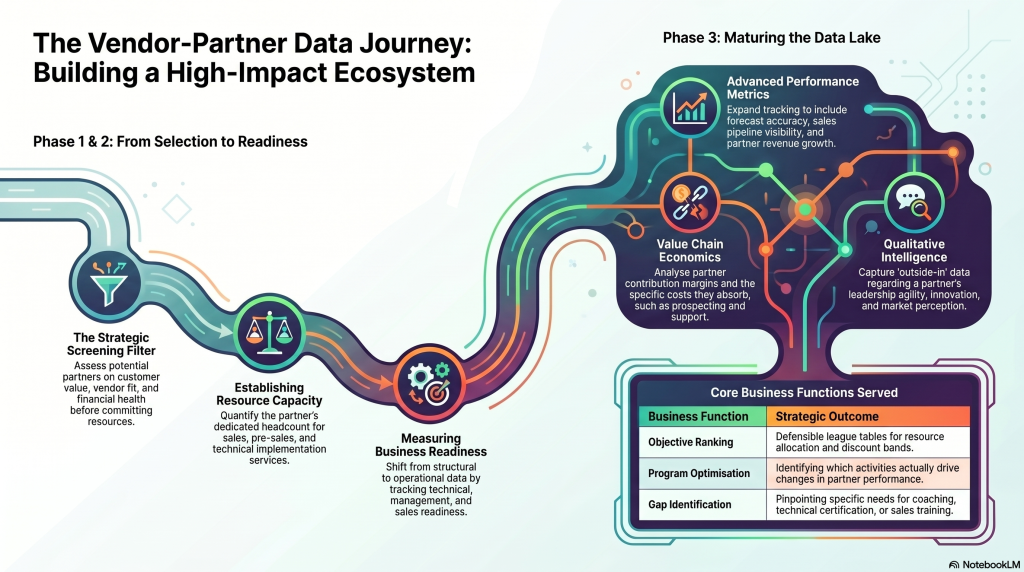
Before any resources are committed, potential partners should pass through a proactive screening process consisting of three primary filters: Customer Value, Vendor Fit, and Relationship. During this initial phase, the data captured is highly strategic and essential for determining if the partner is a good bet for investment. Note though that even early on, we need to build a picture based on numeric and analogue style data.
Essential Data to Capture in these three categories:
- Strategic & Organisational Data: The type of organisation they are today (e.g., VAR, System Integrator, Services/Consultancy), the nature of their ownership, and whether their long-term strategy and ambition aligns with the vendor's ecosystem plan.
- Financial Health: Overall company sales revenues, growth, profitability, and the specific percentage of revenue derived from the sources you want them to focus on. For example, software ARR.
- Resource Capacity: The number of dedicated full-time salespeople, the ratio of sales to pre-sales personnel, and the headcount of dedicated implementation services staff, with different skill sets
- Market Position: The strength of the partner's brand in the target market, their specific market sector focus, and whether they possess a defined and unique value proposition. Remembering that this means you really have to understand and articulate what this market really is.
Phase 2: Revenue Readiness & Tactical Assessment (Expanding the Data Set)
Once a partner is selected, the focus shifts to making them capable of performing. This requires tracking their progress through a structured "Business Readiness" process. In channel, this would be across four domains: Technical, Management, Sales & Marketing, and Operational readiness. But other types of partners, for example influencers, will be measured, and measure themselves, differently. Therefore your readiness metrics will be different.
At this stage, the data captured shifts from structural to operational.
Essential and Nice-to-Have Data (using the channel example):
- Sales Cycle Metrics (Essential): Deal lead times, the frequency of contact with target markets, and the effectiveness of their lead management processes.
- Implementation & Post-Sales Data (Essential): Today, this will relate to your Customer Success metrics, but don’t think this is new! For decades, partners have measured themselves on their ability to maximise share of wallet, long after the core “product” sale. Reflecting back on work for the 1990, we measured customer satisfaction with delivering outcomes at partners in the UK.
- Marketing Execution (Nice-to-Have): The percentage of the partner's budget dedicated to marketing, their co-operation on joint campaigns, and the number of documented, referenceable customers they possess. This often provides a leading indicator of successful market engagement, even if, ultimately, you are only interested in the number of opportunities they bring to the party.
- Motivation & Operations (Nice-to-Have): Staff turnover rates, the competitiveness of the partner's sales compensation packages, and their responsiveness to vendor incentives.
Phase 3: Long-Term Performance (Maturing the Data Lake)
As the relationship matures, the metrics used to assess the partner must transition again. Early in the relationship, data might focus simply on the number of deals, revenue, projects, and new partners. Over time, the data lake expands to track deeper, more complex indicators of mutual success.
Expanding the Data Lake:
- Advanced Performance Metrics: The data lake should grow to include metrics such as partner revenue growth, sales cycle time, active partner salespeople, forecast accuracy, and visibility into the partner's sales pipeline. Depending on the depth of relationship, understanding value creation metrics for customers would be the ultimate goal.
- Profitability & Value Chain Economics: Tracking the partner's contribution margins, overall profitability, and the specific costs they absorb (e.g., prospecting, installation, support). This would truly answer the age old questions around the purpose of channel partners
- Qualitative Partner Intelligence: Vendors should capture data directly from the partner, and from as many outside-in sources as possible to assess them, and compare them to benchmarks and market perceptions.. This includes tracking their leadership's ability to develop staff, their organisational ability to respond and be agile, their ability to innovate new offers and ways of taking them to market.
Why is this Data Required and How is it Used?
Capturing this extensive data lake serves several critical business functions for the vendor:
1. Objective Ranking and Resource Allocation:By quantifying strategic and tactical assessment data, vendors can calculate overall "Strategic Development Potential" and "Tactical Development Potential" scores. This allows vendors to compile league tables to objectively rank partners and decide exactly which partners warrant the most focus and investment. Critically, this can also be used for compliance purposes if criteria are defined for things like discount bands, they need to be defensible. This is how.
2. Optimising Channel Programs:Vendors often waste money on channel programs and activities that have no effect on revenue. By using data to understand partner capability changes, due to activities and program elements, and mapping these to actual performance changes, it becomes possible to understand how best to invest in your ecosystem.
3. Identifying Training and Support Gaps:Data regarding a partner's win/loss tactics (e.g., competing on price vs. value-based selling) and their struggles with recruiting technical or sales staff helps vendors pinpoint exactly where to intervene with coaching. If data shows a partner is struggling with implementations, the vendor can mandate further technical certification; if they struggle to close deals, the vendor can target them with specific sales skills training.
4. Conflict Reduction:Capturing data on the partner's target markets, named accounts, and product lines helps vendors establish clear rules of engagement, minimising disruptive channel conflict between the partner and the vendor's direct sales force.
5. Doing Something New: One of the most significant activities for many vendors today is launching new offers potentially into new market geographies. How do you know who is most likely to succeed? The partner who did a big total revenue number for you next year on the same continent? Or the partner who speaks the language of the customer in a highly insular country? Being able to really understand the capability of a partner will help you act better in the future. Tomorrow is rarely today + 20% anymore.
Whilst many people complain about being “assessed out” - to many surveys and questionnaires or quizzes, it is essential we build an understanding of what are ecosystem is capable of in its various components and how it can act coherently. But in return, those assessments need to be inherent in the processes and interactions we have, and not a separate entity. More than that, they need to give the participants real value, with short term coaching and knowledge that the intelligence is actually being used to decide how the game is played.