
1. Stop trying to scale your partner ecosystem by making it cheaper. Start making it smarter.
Can you reduce the cost of managing a partner ecosystem and have better results?
Probably not by doing what most organisations instinctively try first. The real issue isn’t whether a partner ecosystem is cost-effective. It’s whether you’re managing it with the right balance of skill, structure, and scalability.Too often, when costs start to rise, the reaction is predictable: reduce headcount costs, push in more junior resources, and treat channel roles as a stepping stone into “real” sales jobs. On paper, that looks efficient. In reality, it usually creates more drag than it removes. Because not all partners are equal. Your top-performing partners? They often need very little—just someone who can unblock processes and keep things moving. A concierge works. But developing partners—the ones who will drive your next phase of growth—are a completely different story. They require proactive, experienced engagement:and this doesn’t come cheap. You need a team with business management expertise to help the partners shift prosper in new realities. Maybe from services to solutions, embedding marketing capability, building go-to-market clarity.
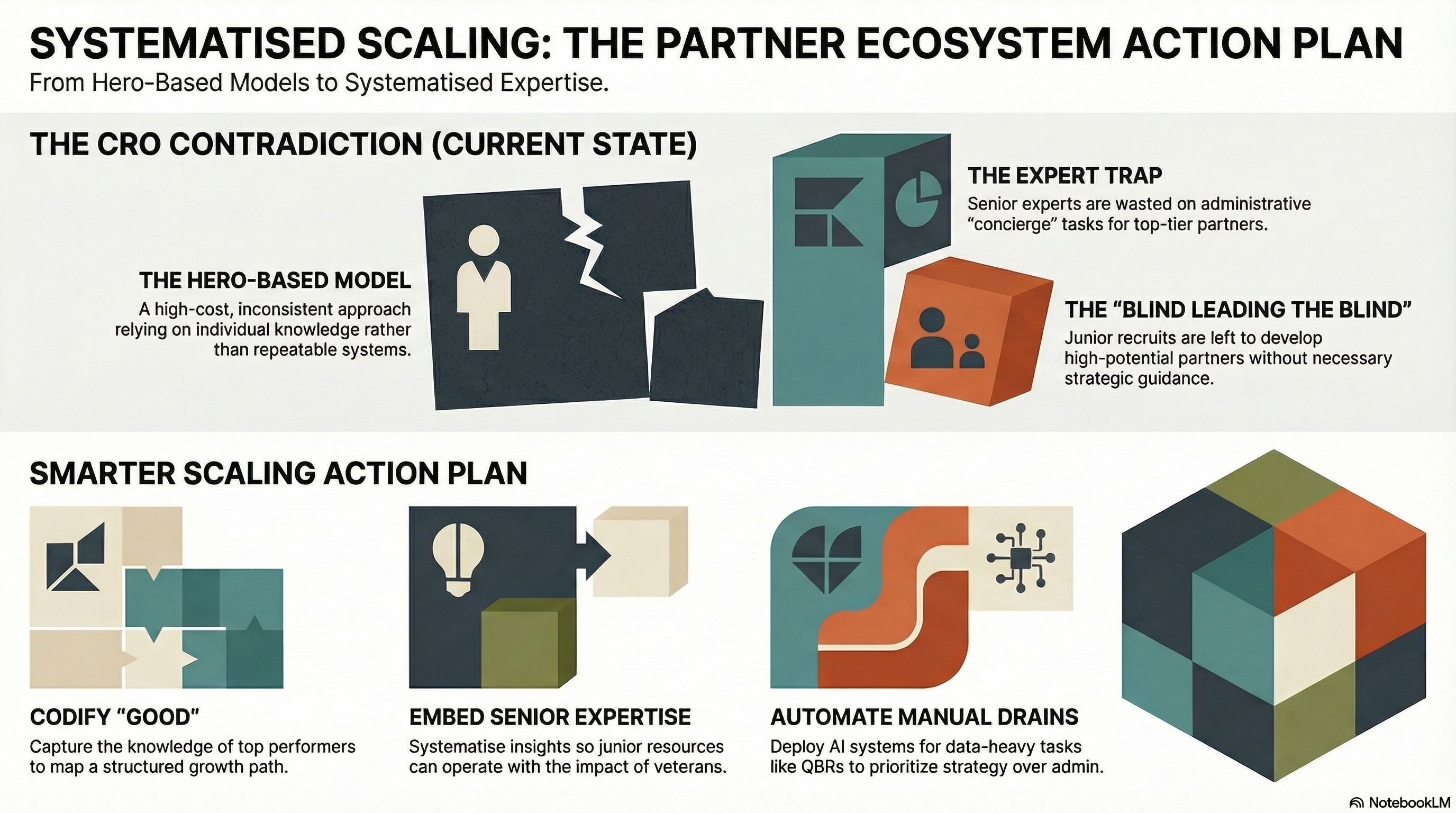
Here’s where many CROs face a contradiction:
- Your best people should not be managing high revenue generating partners today. Instead they need to be nurturing low- or no-revenue partners, but with identified high potential. No one else can bring them to the party quickly.
- Your least experienced people can signpost and network your high revenue partners reacting to their needs, but can they spot a train crash in advance? And endanger your most valuable relationships?
But today that's not how it is. Your experts are working hard managing the risk of your best partner getting it wrong, whilst your new recruit team member is left with the newly recruited partner, with little mutual confidence on how to progress.
So the question becomes:
How do you scale your partner expertise without scaling cost at the same rate?
The answer isn’t more people. It’s capturing and reusing what your best people already know.
Where does the knowledge of how to build a successful partner actually sit today? In individuals. Therefore it is inconsistent, hard to transfer and expensive to replicate.
If you can systemise that—codify what “good” looks like, assess where each partner is starting from, and map a structured path to where they need to get to—you fundamentally change the model.
Now you’re not relying on individuals to reinvent the wheel every time. You’re enabling:
- Senior expertise to be embedded and reused at scale
- Junior resources to operate with far more impact and confidence
- Partner development to become predictable, not artisanal
This is where a structured approach comes into play. Done right, it doesn’t just reduce cost. It matches cost to real requirement.
It also removes one of the biggest hidden drains on partner teams: manual effort.
Think about something as simple—but critical—as a quarterly business review.
How much time is spent pulling data together, chasing inputs, building a coherent picture?
Now imagine:
- A system that already understands the partner’s maturity, goals, and activity
- Automatically generates a structured, insight-driven QBR input
- Frees your team to focus on conversation and strategy, not admin
That’s where real cost reduction happens—not by cutting capability, but by amplifying it.
Already looking for help? Check out Virtual Partner Manager. Or our website
PS - By the way, if you are wondering,
The six AI coaching lenses referred to in the infographic at the top are areas where Artificial Intelligence can help you shift from being a reactive problem-solver to a proactive coach for your partner ecosystem. They are:
Planning Gap Resolution: Once gaps are identified, AI helps analyze them to determine a mid-term roadmap of activities. This resolution plan might involve personal development, new business acquisition, recruitment, or teaming up with other partners to fill the missing capabilities
Setting Objectives: AI can act as a brainstorming environment to help set objectives that go far beyond simple revenue targets, allowing you to explore "what could be" for the partnership and incorporate pipeline roadblocks as operating requirements.
Analyzing Capabilities: To understand the true skills your team and partner community possess, AI can analyze vast amounts of informal data beyond your standard systems of record, including meeting transcriptions, social media posts, personal blogs, and customer feedback sites.
Understanding Ambition: AI can facilitate discussion-style interviews to grasp the specific goals of partner staff. For example, AI can transcribe voice notes provided in local languages and extract key themes to help participants define their personal development goals.
Gathering External Intelligence: AI-based web agents can be deployed to search for market insights that are outside of your direct control, helping you understand what the outside world thinks by scanning customer review sites and analyst opinions.
Mapping Gaps: AI can synthesize all of this gathered data into a coherent report, providing a clear view of the current state of play and mapping out exactly where friction or missing capabilities exist between your objectives and the partner's ambitions.