
4.What are the most important reasons for the existence of a partner ecosystem?
In many vendor management meetings, and sales huddles we hear the question, “Why do we need, or want partners? They never do what we want, we have no control over them and they don’t react at quarter end when we need their orders”
Indeed, there may be a whole list more reasons why a partner program is a painful experience, and elsewhere we will look at some of the reasons why partner ecosystems are hard. But here, let us be positive. Why could partnering be good for you?
Firstly, Partners are not born equal. They are like children. If you have more than one of your own or in your extended family you will be familiar with seeing them together and quickly recognising their differences, even though on the surface they may appear pretty similar! One might be good at sports, 1 academic, 1 a practical fixer, 1 has a social conscience, etc. But unlike your kids, you can choose. What do you really want from a partnership? Are there different business scenarios that impact this choice? - That is where we need to start.
- What skills and capabilities do I want now?
- How will this evolve over time?
- Do I expect to find this in one entity. Realistically?
- What would motivate such a company to want to work with me?
Answers to these questions together will start to define why you would want to have a partner play in your go to market planning, and whether it is singular, or has multiple threads, such as developers and ISVs providing niche offers to specific verticals, but generic resellers in more geographically, linguistically or culturally diverse markets. If these two can be properly motivated and orchestrated, we could then have a multidimensional partner ecosystem. We can then overlay influencers, delivery and fulfillment and other specialisms that would define a highly sophisticated and powerful force in your markets.
So now lets investigate the typical list of reasons why you may have or want to have a channel, and maybe introduce a few new ones.
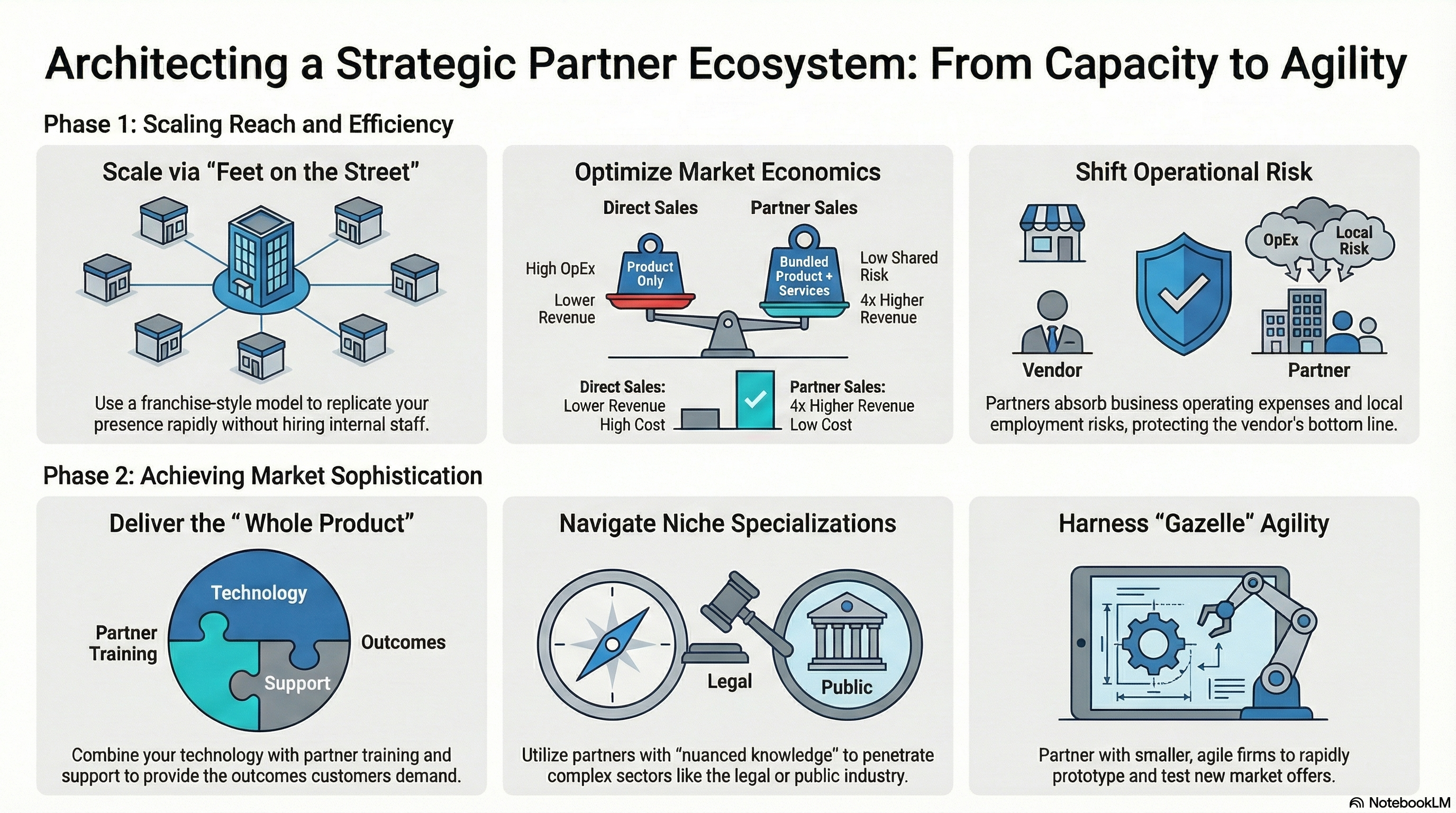
- Feet on the street. Probably the most voiced reason for having a channel is simply to increase your capacity. Create mini-me versions of yourself. Usually the view is they can operate like a hamburger restaurant franchise, with the customer believing they are interacting with you directly, but the reality is a separate business that takes a chunk of risk, manages employment of staff, fulfills demand and if you are lucky builds a relationship with some local customers. In return you provide “look alike marketing and branding” and some operating procedures akin to how hot the grill needs to be to cook 10 burgers at once. Why is this attractive? Once you know the model it is easy to replicate, even down to the layout of the functions. It took McDonalds about 4 years to get to 100 stores, and another 5 to get to 1000. This acceleration is unlikely if you have to do everything yourself. The major disadvantage is, the franchise model does not adapt well to localisation. In India they were surprised few people bought hamburgers. As we know this is a misnomer as they are in fact made from Beef, and the Cow is sacred to many in the Indian sub continent. There are many other examples, of failure because of nuance, but, if you are expanding rapidly in neighbouring markets a simple “feet on the street” rationale could be enough.
- The second most common reason is economics. If you don't have to pay the business operating expense as a vendor, there is a clear saving to be made. Not sure if a new office will be worth it? Let a partner try! In addition, often vendor brands have been seen as prestigious in the employment market, and therefore people working there have higher salary expectations. In many cases partners have a lower fully loaded cost of employment. Also in the economics category comes a view of what a customer buys and what it costs to sell. For example if your product accounts for 25% of what a customer needs, but the partner can provide the other 75% as well, the partner may well be able to invest in markets your business could not do. A prime example is the SME market. You deal becomes too insignificant to build a sales team around, but the partner will, because they can get 4x the revenue. So the benefit to you is, you get your product into customers who you would not want to sell to as the cost would be prohibitive.
- This brings us nicely to the concept of a whole product. Today we talk about buying an outcome, 20 years ago we talked about a One Stop shop or a total solution. The principle is the same. The customer wants an easy to consume solution to a business need, and in many cases this is best achieved by having as few players to deal with as possible. Let one organise the others, so you only have to chase one. But what is a whole product? It could include things like support or AMS, like training or outsourcing, like provision in sovereign territories, but it could also include “features” such as localisations or currency pricing. The benefit to you is that you don’t have to worry about all the things a local full service partner needs to do to win the customer. The down side is, you can become seen as an enabling technology, and your place in the value hierarchy starts to slip.
- Customers are not homogeneous groups, even within the markets you define with your segmentation. They have different and sometimes very specific needs. If you can’t deliver you can’t win their business. Selling to some parts of the Public Sector, especially in markets like the UK requires a business model that many vendors simply find too complex and too long term for the quarterly cycle they operate in. Other examples are some verticals like the legal profession who don’t conform with other service industry profiles and without the nuanced knowledge in every part of the customer engagement you are unlike to get far. In both these cases, you need partners who not only can do these things, but actively promote their capability and are recognised for it, by the customer segment.
- Finally, in many vendor / partner relationships, the partner is orders of magnitude smaller than the vendor. Decision cycles can be minutes spent with the owner, rather than weeks, months or quarters in a large corporation. If you want to do something new, it is often easier to do it with a partner whose agility you can only dream of. Increasingly, it is this last reason for having a channel partner ecosystem that is coming to the fore. Vendors are supertankers, they have a way of working, and to do things differently requires process and changes that might not help the entire business. This is why from a product perspective new things often get built “offsite” but if what you want to do it test new markets with new offers, having an agile partner who can work with you to test and prototype an approach can ensure any changes to the tankers course are correct for heading to success, even if they are slow. Throughout these blogs we refer to these as Gazelle partners and need to be sought out and developed, but not to become a heavyweight, but to replicate, and this takes us full circle, to create franchise of gazelles.
In conclusion, why do you have partners, what type of partners, and how you operate with them are all intertwined. Only only thing is sure, if you are growing it is unlikely you will succeed if you just take a cookie cutter approach and multiply all of the same. And if you are clear about why you have them and the purpose of the partnerships, it will become a lot easier to allay the concerns we hear and get everyone growing through channels to give the customers choice in how they consume your products.